
Late-K Lunacy: A novel
Students at a fictional university in southern Ohio protest the university’s decision to switch to fracked natural gas for heating and cooling. While occupying the main quadrangle of campus, in class they must confront, theoretically and in fact, the prospect of planetary collapse. Complexity science lends frightening authenticity as the story unravels and the author challenges readers to imagine a Late-K struggle toward a better tomorrow.
“Panarchy invites us to conceive of the world as a vast interlocking set of interactive systems that pass through phases over time. If we can thoroughly understand the implications of panarchy’s dynamic, we can perhaps begin to avoid behaviors that quicken the progression of human and ecological systems toward collapse. That is the challenge before us now.” — professor Katja Nickleby in Late-K Lunacy, citing her work “Over the Cliff”.
Copies are available from Petra Books, White’s Mill, Little Professor, and Amazon.
What people say about Late-K Lunacy
I’ve long found this a compelling scenario, and Bernard gripped me hard with this book. It’s filled with young—and a few older—idealists who are trying to prevent an initial, relatively small disaster involving a university in southern Ohio, as well as state and local policies regarding fracking and toxic waste. In scene after scene the conflict gets out of hand, which makes for a lively story. It doesn’t seem, through most of the book, that the whole world is going to fall apart because of some nefarious frackers and corrupt administrators—but that’s how a late-K lunacy can start, engendered by something that’s vital to only a few, then escalating until the system “loses its resilience and is highly vulnerable to sudden collapse into the next stage, which is omega.”
— John Thorndike, author of The World Against Her Skin and A Hundred Fires in Cuba
Rachel Carson’s Silent Spring opens with a dystopian portrait of a fictitious town dying from pesticides. Mocked by corporate agribusiness, her non-fiction best-seller became the generative force for the modern environmental movement. Late-K Lunacy follows in this tradition with fiction, this time the threat to human and ecological life being a climate change-induced pandemic. It will frighten the complacent and arm climate justice advocates. Ted Bernard has an engaging and imaginative gift for ecology-based fiction.
— H. Patricia Hynes, author of The Recurring Silent Spring and Professor Emeritus, Boston University
A devastatingly truthful work of ecology-based fiction and a gripping story of the coming-of-age of a group of post-carbon Millennials. Much more than an ecological dystopia, Late-K Lunacy is a splendid evocation of the world going into—and eventually coming out of—an ecological crisis.
— Fikret Birkes, author of Sacred Ecology
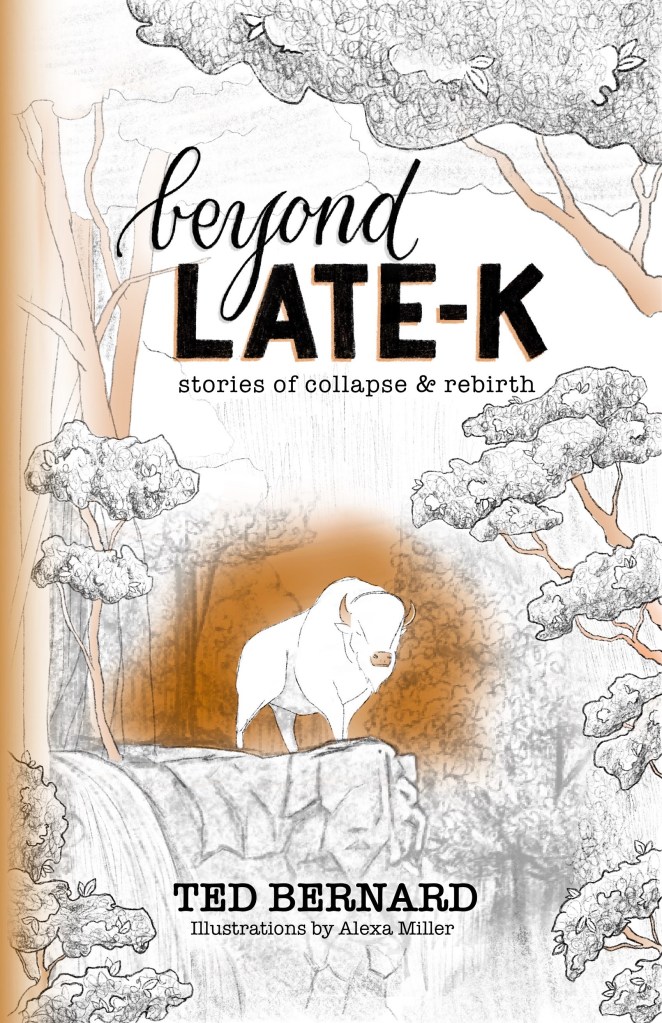
Beyond Late-K: stories of collapse and rebirth
Two generations after Late K, villagers continue to forge their lives in the aftermath of the breakdown of civilization. In this story cycle novel, ten vignettes explore the legacy of Late-K Lunacy. Each is a searing exploration of how people are faring decades after the world came unhinged, how families and villages survive in the hardest of times. Faced with daily struggles against the odds of ecological disruption, climate change, human infertility, and constantly strained relationships, people’s very humanity is put to the test. Here are heart-rending love stories, a tale of survival through two pandemics, an epic migration, a witch and a twisted gaggle of monks, and gritty tales of women holding fast when all else goes wrong.
Copies are available from Petra Books, White’s Mill, Little Professor, and Amazon.
What people are saying about Beyond Late-K
Bernard handles male and female and alternative-gendered characters equally well, with a perceptive eye toward the strengths and weaknesses of all. Mostly, his primary characters possess a strong work ethic and an inborn wisdom that is needed for their embrace of a world with just a partial skeleton of the previous political and social structure. The southern Ohio communities of the stories are naturally multidimensional and multicultural, with the egalitarian tendencies one would expect of most humans when physical survival is enhanced by cooperative behavior in a post-carbon world.
— Kate Robinson, The U.S. Review of Books
Picking up where his novel Late-K Lunacy left off, here is a candid exploration of how various characters in the future cope with the “harsh simplicity” of a decimated world.
— Kathleen Davies, author of Sacred Groves: Or, How a Cemetery Saved My Soul
Though a sequel to Late-K Lunacy (2018), this novel stands comfortably on its own, with a firm focus on the survivors rather than the catastrophe; its characters’ origins and motivations are presented candidly and with great pith.
An engrossing, character-driven cautionary look at a stark possible future.
— Kirkus Reviews
 Author Ted Bernard