1
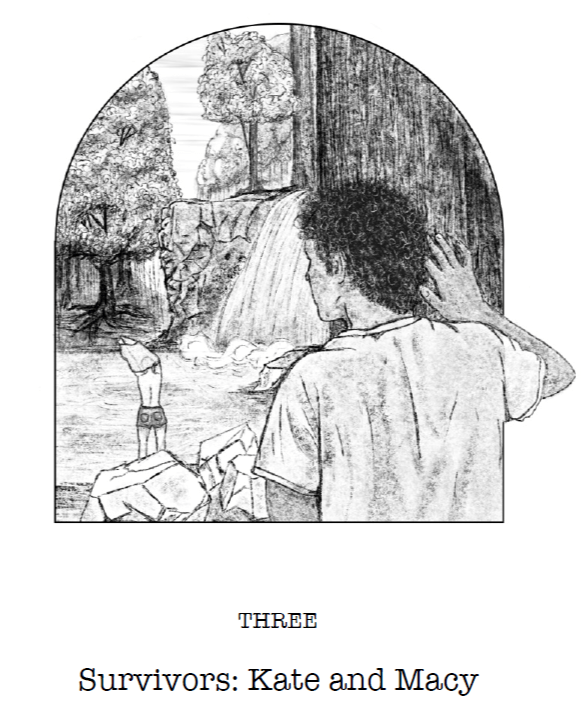
KATE WALKED HOME along one of the neighborhood lanes in what used to be the town of Argolis. At the mill sorting documents her father had found in a dark corner, she had only been gone a couple of hours. She entered the house and discovered her aunt’s body — lying with her head in the oven.
She knelt beside the still woman, found no signs of life. Wracked
in disbelief, she tugged the body across the kitchen onto a woven rug in
the dining area. Cradling her aunt, she lowered her head onto a pillow.
And then she crumpled to the floor alongside her. Hours later, awakened by footsteps, she sat up abruptly, rubbing her temples, aghast at the corpse at her side. Her lips began to quiver. Her father looked down on her. “Oh, sweetheart, poor Auntie Lara gone way too soon. We’ll need to plan a memorial.”
“Dad,” she blubbered. “Auntie’s head was in the oven.”
They buried her in the place where her partners also lay, one the victim of gunfire thirty years earlier, the other, a few years later, of a fall from the mill roof. At the ceremony, people spoke of Lara’s grit, the tragedies of her life, her deep knowledge of the forest and its birds, her never completed PhD. When the mourners had parted, Kate and Macy tossed stories back and forth — Lara’s midlife slump and resurgence, her randy son David, the night she showed up to sleep with Kate’s father, her illness and death at fifty-five.
“She was old and sick,” Macy said. “Ready to die.”
“What an awful way to go. Sure, her life was hard — so is everybody else’s — but checking out this way? Would you have expected it?”
“Never. I mean, when we were kids, we heard about people who were starving doing themselves in. But nobody I’ve ever known has died by suicide.”
Macy cast her glance at Kate and saw in her face a clouded solemnity. Macy knew that look, the bleakness lurking beneath Kate’s cheerful guise. After all, Kate had been raised by a professor who taught about a desperate end-stage for the world, a stage called ‘Late-K’. No wonder she felt hopeless sometimes. Kate turned away to watch the river in the blood orange twilight. An evening breeze flowed across their blanket and swooshed the maple. Mourning doves began their evening coos. Macy reached over to her friend. She spoke her name. They embraced, their hips responding with a longing neither chose to acknowledge, at best, an awkward hug.
Though their community sought to be resilient in forbidding times and seemed friendly enough day-to-day, when it got down to personal histories and sensibilities, as with any sample of humans in good times or bad, relationships were fraught with heartache and pain.
Years ago Macy, a scraggly waif, showed up one night in Blackwood Forest, miles from here. She was barely two, her mother dead of an overdose, her father never known. A couple took Macy into their home, raised her until they no longer could. They believed her to be cursed. Latent heroin in her blood. In her early teens they sent her over the hills to live with the widow Lara and her son. “I’ve got this stigma,” she claimed.
Kate pulled away. They got up off the ground, dusted off. “You’re not the only one,” Kate said. “My story’s as fucked-up as yours.”
“I seriously doubt it.”
“Can you say you never met your mum? Have you been raised, quote unquote, by a bloke too distracted to be a proper dad, a man swallowed up with guilt and constantly hounded by disgusting women who might have become dastardly stepmothers? It’s no wonder we feel pathetic. Here we are fully adult, sexually unrequited, trying to make a future in a place with virtually no opportunities.”
“Pathetic is right,” Macy agreed. “But sexually unrequited? What are you saying? Should we revisit that story? Or should we forget it and begin a new one, basking as we are in cuddly dampness?” Kate bit her tongue. Trash-talking a hot phase of their lives was not a great idea. But let’s not get ahead of ourselves.
Kate still lived with her dad, Stefan, the village’s most respected elder. After Kate’s mother bled-out at childbirth, he bumbled through single parenthood in the hardest of times. His daughter grew up independent, callous at times, and self-aware, thanks to a couple of aunties — as her dad liked to think of them — rushing in and out with garden produce, soup and baked goods, home stitched garments, and more than occasional bouts of intercourse remorse. Lara was the latest and best. As she became more and more ill, she retreated to a separate bedroom. Stefan hardly looked in on her, leaving Kate to her care. Her death may have restored a bit of tranquility and it did resolve two problems; Kate could get back to work, and Stefan could try to shed more guilt. But Kate could hardly bear the loss.
Homebase was a tiny isolated village in what once was southeastern Ohio. As survivors of Late-K and collapse, the few dozen residents lived crudely in abandoned houses and buildings along a river at the outskirts of the once thriving university town of Argolis. Neither woman could recall anything about the world at their birth, a world that elders grimly remembered but were reluctant to talk about. There was so much the girls did not know, no matter how many times they pleaded for details. All they were able to discern was that it was a time when connectivity meant something other than the engagement of people in each other’s lives, and that something called social media induced waves of hatred and separation so extreme that the country ripped apart. Why humans and governments were unable to rise above this non-human thing had never been explained.
…


 Author Ted Bernard